Facts checked Article
Baccarat education
When does the banker draw a third card in baccarat?: the rule, the totals, and the exact odds
Banker draws a third card by a fixed table: on 0 to 5 if Player stood, and by Player’s third card on 3 to 6 if Player drew. Every row, its frequency over eight decks, and the cost per £10.
When does the banker draw a third card in baccarat?
Banker draws a third card according to a fixed table, and the decision is taken only after the Player hand is complete. If Player stood on 6 or 7, Banker draws on a total of 0 to 5 and stands on 6 or 7.
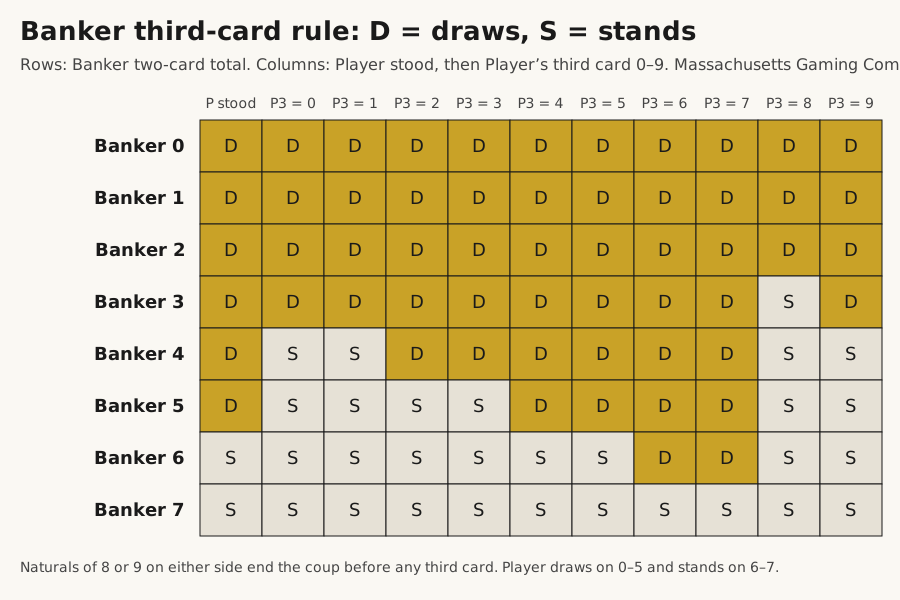
If Player drew, Banker’s move depends on Banker’s own two-card total and on the value of Player’s third card. On 0, 1 or 2 Banker always draws; on 7 Banker always stands; on 3, 4, 5 or 6 the third card decides. A natural 8 or 9 on either side ends the hand before any third card.
These are the rules as published in the Massachusetts Gaming Commission’s baccarat rulebook, section 11, read 21 September 2026.
In hand-total notation the cases look like this. P 6 · B 5 → Banker draws, because Player stood and 5 is within 0 to 5. P 4 draws a 9 · B 3 → Banker draws, because Banker 3 draws against every third card except an 8.
P 2 draws an 8 · B 3 → Banker stands. P 5 draws a 6 · B 6 → Banker draws. P 5 draws a 5 · B 6 → Banker stands.
P 8 → natural, nobody draws.
Nobody at the table chooses any of this. “Player” and “Banker” are the names of two hands, not of the people betting on them, and the dealer or the software applies the table without discretion. That is why the question has an exact answer rather than a tendency.
Sources: Massachusetts baccarat rules, s.6, s.11 and s.13.
The fixed reference
- Player hand
- Draws on a two-card total of 0 to 5; stays on 6 or 7; 8 or 9 is a natural and ends the hand (s.11)Massachusetts baccarat rules, s.6, s.11 and s.13 · as checked on
- Banker hand, Player stood
- Draws on 0 to 5, stands on 6 or 7 (s.11(c)(1))Massachusetts baccarat rules, s.6, s.11 and s.13 · as checked on
- Banker hand, Player drew
- Draws on 0 to 2; stands on 7; on 3 to 6 the draw depends on Player’s third card (s.11(c)(2), Table 1)Massachusetts baccarat rules, s.6, s.11 and s.13 · as checked on
- Eight-deck outcomes
- Banker 45.86%, Player 44.62%, Tie 9.52% of handsWizard of Odds, baccarat basics · as checked on
- Rules before the bet
- RTS 3A: the applicable rules must be easily available before the customer commits to gambleGambling Commission RTS 3 · as checked on
Settling any coup from the drawing table
The order in which the rules apply, as section 11 of the Massachusetts rulebook prints them. Nobody at the table chooses any of it.
Check for a natural first
If either hand shows 8 or 9 on its two cards, the coup ends at once. No third card is dealt to anyone.
Read Player’s total
Player draws on a total of 0 to 5 and stands on 6 or 7. There is no choice and no fourth card.
If Player stood, read Banker alone
With Player standing on 6 or 7, Banker draws on a total of 0 to 5 and stands on 6 or 7 (s.11(c)(1)).
If Player drew, row then column
Banker’s two-card total picks the row of Table 1 and Player’s third card picks the column. On 0, 1 or 2 Banker always draws; on 7 Banker always stands; on 3, 4, 5 or 6 the third card decides.
What the result means
The card was already determined by the rule before it was turned. The row, then the column, then the card settles every case, and the dealer or the software applies the table without discretion.
What are the conditions for the player to draw a third card in baccarat?
Player acts first, and Player’s condition is the simple one. Each hand receives two cards. If either hand shows 8 or 9, the coup ends at once and no third card is dealt to anyone.
Otherwise Player draws on a total of 0 to 5 and stands on 6 or 7. There is no choice and no fourth card.
Totals are counted under section 6 of the same rulebook: cards 2 to 9 count their face value, tens and court cards count zero, and an ace counts one. A two-digit total keeps only its right-hand digit, so ace, 2, 9 is 12 and counts as 2, and 7, 8 is 15 and counts as 5.
P 5 draws; P 6 stands.
How often does each branch happen? We enumerated every possible deal from a 416-card, eight-deck shoe and applied section 11 exactly; the script and its output are in the evidence folder for this draft. A natural on one side or both ends 34.30% of coups before any draw.
Player draws in 50.34% of coups. The remaining coups are the ones where Player stood on 6 or 7 and Banker alone decided.
Sources: Massachusetts baccarat rules, s.6, s.11 and s.13.
Counting a total under section 6
- Cards 2 to 9
- Count their face valueMassachusetts baccarat rules, s.6, s.11 and s.13 · as checked on
- Tens and court cards
- Count zeroMassachusetts baccarat rules, s.6, s.11 and s.13 · as checked on
- Ace
- Counts oneMassachusetts baccarat rules, s.6, s.11 and s.13 · as checked on
- Two-digit totals
- Keep only the right-hand digit: ace, 2, 9 is 12 and counts as 2; 7, 8 is 15 and counts as 5. P 5 draws; P 6 stands.Massachusetts baccarat rules, s.6, s.11 and s.13 · as checked on
What triggers the banker to draw a card in mobile baccarat apps?
The trigger is the same table. An app does not have a different rule for Banker; it has software applying section 11, or its equivalent in the operator’s own published rules, to the cards it has dealt. What differs between products is the payout schedule, not the draw.
For a GB-licensed operator the document that governs your hand is its own help page, and the Gambling Commission’s technical standards say where to find it. RTS 3A requires that “an explanation of the applicable rules must be easily available to the customer before they commit to gamble”, with the number of decks among the details to be given.
RTS 3C requires the house edge, return to player or probability of winning to be available in the same way. Read 21 September 2026.
If an app’s help page prints a Banker table that differs from the one below, the help page governs that game. A table that matches it, with eight decks, produces the probabilities in this essay. The tap that reveals the third card changes nothing; the card was already determined by the rule.
Sources: Gambling Commission RTS 3; Massachusetts baccarat rules, s.6, s.11 and s.13.
when does the banker draw another card in baccarat
“Another card” can only mean the third card. Each hand holds two or three cards and never four, so a coup uses four, five or six cards in total. Banker draws in 43.54% of eight-deck coups by our enumeration; in the rest, Banker either stands, holds a natural or faces one.
The frequency of each Banker row is uneven. A two-card Banker total of 0 arises in 11.94% of coups, because tens and court cards are 128 of the 416 cards and any pair of zeros totals zero. Totals 1 to 7 each arise in roughly 7.7% of coups.
Given that a row is reached, Banker draws every time on 0, 1 and 2; 94.09% of the time on 3; 58.71% on 4; 46.92% on 5; 11.75% on 6; and never on 7.
The Banker-6 row is the one people misremember: Banker draws there only against a Player third card of 6 or 7, and only after Player has drawn.
B 6 with Player standing on P 6 or P 7 is a stand, not a draw. B 6 against P 3 draws a 7 (P 0) is a draw. The row, then the column, then the card: that order settles every case.
Sources: Massachusetts baccarat rules, s.6, s.11 and s.13.
How often each Banker row is reached, and how often Banker draws from it
| Banker two-card total | Share of coups reaching the row | Banker draws from the row | Evidence |
|---|---|---|---|
| 0 | 11.94% | Every time | · Massachusetts baccarat rules, s.6, s.11 and s.13 |
| 1 | Roughly 7.7% | Every time | · Massachusetts baccarat rules, s.6, s.11 and s.13 |
| 2 | Roughly 7.7% | Every time | · Massachusetts baccarat rules, s.6, s.11 and s.13 |
| 3 | Roughly 7.7% | 94.09% of the time | · Massachusetts baccarat rules, s.6, s.11 and s.13 |
| 4 | Roughly 7.7% | 58.71% of the time | · Massachusetts baccarat rules, s.6, s.11 and s.13 |
| 5 | Roughly 7.7% | 46.92% of the time | · Massachusetts baccarat rules, s.6, s.11 and s.13 |
| 6 | Roughly 7.7% | 11.75% of the time, and only against a Player third card of 6 or 7 | · Massachusetts baccarat rules, s.6, s.11 and s.13 |
| 7 | Roughly 7.7% | Never | · Massachusetts baccarat rules, s.6, s.11 and s.13 |
The frequencies are our own computation over a 416-card shoe, not a published figure; the rulebook cited is the source of the rule enumerated. A natural 8 or 9 on either side stops all drawing before any row is reached.
Can I get a detailed guide on baccarat third card rules from popular gaming sites?
Three kinds of document carry the rule with enough detail to settle a hand, and this essay cites one of each. A regulator’s rulebook prints the full table with section numbers; the Massachusetts text is a published example of the standard punto banco procedure.
A licensed operator’s help page must, under RTS 3A, print the rules that apply to its own game. A published mathematics reference prints the same Banker table beside the probabilities it produces. Wizard of Odds, read 21 September 2026, gives Banker 45.86%, Player 44.62% and Tie 9.52% with eight decks.
Our enumeration reproduces those figures to six decimal places.
A guide that stops at “bet on Banker” without printing the Banker table is not a guide to the third card, whoever publishes it. We do not rank sites; we say what a page must contain to answer this question. It must contain the eight rows below.
Sources: Wizard of Odds, baccarat basics; Gambling Commission RTS 3.
Three kinds of document that settle a hand
This essay cites one of each. A page that does not print the eight rows of the Banker table cannot answer the question, whoever publishes it.
Ticks are kept only in this browser and are never sent anywhere.
The table: the drawing-rule table done properly
Table 1 is the whole rule, one row per Banker two-card total, with the Player-stood column and the Player-drew columns separated so that no case is ambiguous. The last two columns are ours: how often each row is reached in an eight-deck shoe, and how often Banker draws from it, computed by exact enumeration of the rules in section 11.
The outcome probabilities that the table produces are 45.86% Banker, 44.62% Player and 9.52% Tie. With the 5% commission on Banker wins, a £10 Banker stake costs 10.6p per coup in expectation, and a £10 Player stake costs 12.4p. A £10 Tie stake costs £1.44 at 8 to 1 and 48.4p at 9 to 1.
Those are Wizard of Odds’ house-edge figures, 1.06%, 1.24%, 14.36% and 4.84%, applied to £10 and rounded to the penny.
| Banker two-card total | Player stood on 6 or 7 | Player drew: Banker draws when Player’s third card is | Player drew: Banker stands when Player’s third card is | Share of eight-deck coups reaching this row | Banker draws from this row |
|---|---|---|---|---|---|
| 0 | Draws | 0, 1, 2, 3, 4, 5, 6, 7, 8, 9 (always) | Never | 11.94% | 100.00% |
| 1 | Draws | 0 to 9 (always) | Never | 7.69% | 100.00% |
| 2 | Draws | 0 to 9 (always) | Never | 7.66% | 100.00% |
| 3 | Draws | 0, 1, 2, 3, 4, 5, 6, 7, 9 | 8 | 7.69% | 94.09% |
| 4 | Draws | 2, 3, 4, 5, 6, 7 | 0, 1, 8, 9 | 7.66% | 58.71% |
| 5 | Draws | 4, 5, 6, 7 | 0, 1, 2, 3, 8, 9 | 7.69% | 46.92% |
| 6 | Stands | 6, 7 | 0, 1, 2, 3, 4, 5, 8, 9 | 7.66% | 11.75% |
| 7 | Stands | Never | 0 to 9 (always) | 7.69% | 0.00% |
Sources: Massachusetts baccarat rules, s.6, s.11 and s.13; Wizard of Odds, baccarat basics.
The Banker third-card rule
| Banker two-card total | If Player stood (6 or 7) | If Player drew: Banker draws on Player’s third card of | If Player drew: Banker stands on | Evidence |
|---|---|---|---|---|
| 0, 1 or 2 | Draws | Any card | Never | · Massachusetts baccarat rules, s.6, s.11 and s.13 |
| 3 | Draws | Any card except 8 | 8 | · Massachusetts baccarat rules, s.6, s.11 and s.13 |
| 4 | Draws | 2, 3, 4, 5, 6 or 7 | 0, 1, 8 or 9 | · Massachusetts baccarat rules, s.6, s.11 and s.13 |
| 5 | Draws | 4, 5, 6 or 7 | 0, 1, 2, 3, 8 or 9 | · Massachusetts baccarat rules, s.6, s.11 and s.13 |
| 6 | Stands | 6 or 7 | 0, 1, 2, 3, 4, 5, 8 or 9 | · Massachusetts baccarat rules, s.6, s.11 and s.13 |
| 7 | Stands | Never | Any card | · Massachusetts baccarat rules, s.6, s.11 and s.13 |
| 8 or 9 (natural) | No draw either side | No draw either side | No draw either side | · Massachusetts baccarat rules, s.6, s.11 and s.13 |
The Evidence column dates the reading of the rulebook. Frequencies are in Table 1 in the prose, where they are labelled as our own computation.
A worked example in pounds
Take a £20 stake on Banker. The deal is P 6 · B 5. Player stands on 6.
Banker, at 5 with Player standing, draws under s.11(c)(1). Suppose the third card is a 2: B 7 beats P 6. The winning Banker wager is paid at 1 to 1 less a vigorish of 5% of the amount won, section 13, so the profit is £19 and £39 comes back.
The same stake on Player would have lost £20; the same stake on Tie would have lost £20.
Now the expectation rather than one coup. At the Wizard of Odds house-edge figures for eight decks, a £20 Banker stake costs 21.2p per coup on average, a £20 Player stake 24.7p, and a £20 Tie stake at 8 to 1 costs £2.87. Over 100 coups at £20 the expected costs are £21.16, £24.70 and £287.20.
The calculator below applies the same three percentages to any stake and any number of coups; it shows cost, because that is the only figure the rule fixes.
At a commission-free table the draw is unchanged and the payout is not. Where a winning Banker total of six pays 1 to 2, the Banker edge with eight decks is 1.46% by the same reference, so a £20 stake costs 29.2p per coup instead of 21.2p. A road is a record, not a forecast.
If following one has cost more than intended, GamCare’s helpline is 0808 8020 133.
Sources: Massachusetts baccarat rules, s.6, s.11 and s.13; Wizard of Odds, baccarat basics; Wizard of Odds, commission-free baccarat.
Expected cost of a run of coups
Stake, number of coups and the three published eight-deck house-edge figures (Banker 1.06% with 5% commission, Player 1.24%, Tie 14.36% at 8 to 1). Output is the expected cost in pounds, not a result.
Worked example: with stake per coup £20.00, number of coups 100, expected cost on banker (1.06%) is £21.20 and expected cost on player (1.24%) is £24.80 and expected cost on tie at 8 to 1 (14.36%) is £287.20. £20 for 100 coups: £21.20 on Banker, £24.80 on Player, £287.20 on Tie.
Formula and figures: Wizard of Odds, baccarat basics
What this page does not tell you
It does not tell you which operators offer which payout schedule. The commission figure and the tie odds on any given table are on that table’s help page, and only there. It does not give six-deck or single-deck figures; the reference cited carries them, and the Banker table is the same, but the percentages move a little.
It does not cover side bets, which have their own tables and their own costs.
The Massachusetts rulebook is a United States regulator’s text, cited here as a complete published statement of the standard rules. It does not bind a GB operator; the operator’s own rules do, and RTS 3 says they must be available before you bet. Whether a live-dealer stream shows the third card promptly is a question for Live Table Notes.
Why a fixed edge cannot be staked away is a question for Odds & Ends, which this site cites rather than repeats.
Sources: Gambling Commission RTS 3.
Terms used in this essay
- Natural
- A two-card total of 8 or 9 on either hand. It ends the coup before any third card is dealt.
- Third-card rule
- The fixed table that says whether Player, then Banker, takes a third card. Neither hand ever takes a fourth.
- House edge
- The share of each stake a bet costs in expectation over many coups, with the payout and any commission applied.
- Return to player
- The share of stakes a bet returns in expectation; the house edge is the remainder.
- RTS
- The Gambling Commission’s remote gambling and software technical standards, which say what a GB-licensed game must publish before a bet.
- Commission on Banker
- The 5% the operator keeps from a winning Banker wager under the standard rules; commission-free tables change the payout instead.
Questions answered
The six questions below are the stored phrasings readers use for this rule; each answer gives the rule first and the source second.
Questions answered
How do different casinos handle the banker's draw in baccarat?
The same way: the Banker table is a fixed part of the published rules, so casinos differ on the payout lines, not on when Banker draws. The lines that vary are the 5% commission, a commission-free variant, and 8 to 1 or 9 to 1 on the Tie. Under RTS 3A a GB operator must make its rules easily available before you bet, so the help page is where the differences are printed.
Source: Gambling Commission RTS 3
How do online casino platforms explain baccarat third card rules?
Usually as a two-part table: Player draws on 0 to 5 and stands on 6 or 7; Banker’s row depends on its own total and on Player’s third card. The wording follows the same rule the Massachusetts rulebook prints in section 11, and Table 1 above sets it out row by row.
How does the banker's draw rule affect baccarat betting systems?
It does not change any bet’s expectation. The rule fixes Banker at 45.86%, Player at 44.62% and Tie at 9.52% of coups over eight decks, and a staking pattern changes how much is at risk on each coup, not the 1.06% or 1.24% cost per pound.
Source: Wizard of Odds, baccarat basics
What are the baccarat third card rules explained simply?
Player draws on 0 to 5 and stands on 6 or 7. Banker always draws on 0 to 2 and always stands on 7. On 3 to 6 Banker draws only if Player’s third card is in the range for that total: 3, anything but 8; 4, 2 to 7; 5, 4 to 7; 6, 6 or 7. A natural 8 or 9 on either side stops everything.
What are the rules for the banker drawing cards in online baccarat games?
The same table, applied by software rather than by a dealer. For a GB-licensed game the operator’s own help page is the document that governs your hand, and RTS 3A requires it to be easily available before you commit to the bet.
Source: Gambling Commission RTS 3
when does the banker draw in baccarat
When Player stood, Banker draws on 0 to 5. When Player drew, Banker draws on 0 to 2 always, on 3 to 6 according to Player’s third card, and never on 7. Naturals of 8 or 9 end the hand before any draw.
Sources checked 21 September 2026
Every rule in this essay was read from the documents below on 21 September 2026. The frequencies in Table 1 are our own exact enumeration of those rules over a 416-card shoe. The script and its output sit in the evidence folder for this draft, and they reproduce the published outcome probabilities to six decimal places.
Documents read
Read on 21 September 2026; re-check with the next refresh of this article.
| Source | Publisher | Read on | Re-check due | Note |
|---|---|---|---|---|
| Massachusetts baccarat rules, s.6, s.11 and s.13 | Massachusetts Gaming Commission | On the next revisit | Text extracted with pdftotext on 21 September 2026. s.6: 2–9 face value, 10/J/Q/K zero, ace one, two-digit totals keep the right digit. s.11(a): a Natural on either side ends the deal. s.11(b): Player draws on less than 6, stays on 6 or more. s.11(c)(1): if Player stood, Banker draws on 5 or less. s.11(c)(2): if Player drew, Banker draws on less than 3, stands on 7, and on 3–6 follows Table 1 (3: draws unless Player’s third card is 8; 4: 2–7; 5: 4–7; 6: 6–7). s.13: Player pays 1 to 1, Tie at least 8 to 1, Banker 1 to 1 less a 5% vigorish on the amount won. | |
| Gambling Commission RTS 3 | Gambling Commission | On the next revisit | Page last updated 7 May 2024. RTS 3A: “An explanation of the applicable rules must be easily available to the customer before they commit to gamble.” Guidance lists card deck specifications among the content. RTS 3C: house edge, RTP or probability of winning easily available before the gamble. | |
| Wizard of Odds, baccarat basics | Wizard of Odds | On the next revisit | Eight decks: Banker wins 0.458597, Player 0.446247, Tie 0.095156; house edge Banker 1.06% (0.95 payout), Player 1.24%, Tie 14.36% at 8 to 1 and 4.844% at 9 to 1. Banker rule table: 7 stands; 6 draws on 6–7; 5 on 4–7; 4 on 2–7; 3 on all except 8; 0–2 on all. | |
| Wizard of Odds, commission-free baccarat | Wizard of Odds | On the next revisit | “Super 6” style: winning Banker pays even money except a winning total of six pays 1 to 2; house edge 1.46% with eight decks. EZ Baccarat: a winning three-card Banker 7 is a push. Other listed versions range from 0.93% to 6.80% depending on which winning total is cut. |
Questions answered
How do different casinos handle the banker's draw in baccarat?
The same way: the Banker table is fixed in the published rules, so casinos differ on payout lines (commission, commission-free variants, the Tie odds), not on when Banker draws.
How do online casino platforms explain baccarat third card rules?
As a two-part table: Player draws on 0 to 5 and stands on 6 or 7; Banker’s row depends on its total and Player’s third card, as in section 11 of the Massachusetts rulebook.
How does the banker's draw rule affect baccarat betting systems?
It does not change any bet’s expectation: Banker 45.86%, Player 44.62%, Tie 9.52% over eight decks, whatever the staking pattern.
What are the baccarat third card rules explained simply?
Player draws on 0 to 5, stands on 6 or 7; Banker draws on 0 to 2, stands on 7, and on 3 to 6 draws only against the listed Player third cards; naturals end the hand.
What are the rules for the banker drawing cards in online baccarat games?
The same table, applied by software; the operator’s help page governs, and RTS 3A requires it to be available before the bet.
when does the banker draw in baccarat
On 0 to 5 if Player stood; if Player drew, always on 0 to 2, by Player’s third card on 3 to 6, never on 7.
Original rules
- Baccarat rules (Massachusetts Gaming Commission, file dated 11 April 2024)
- Remote gambling and software technical standards: RTS 3 – Rules, game descriptions and the likelihood of winning
- Baccarat basics: rules and eight-deck probabilities
- Commission-free baccarat: Banker variants and their house edges
Continue reading
Player and Banker are names for hands
In a baccarat explanation, Player and Banker identify two hands.
Read Player and Banker are names for hands
Should you bet Banker or Player in baccarat? What the 5% commission really changes
Neither bet wins over time. With 5% commission on eight decks, Banker costs 1.06p per £1 on average and Player 1.24p. The commission is one clause; the rest of the rules decide the rest.
Read Should you bet Banker or Player in baccarat? What the 5% commission really changes
Baccarat roads record results without revealing the next hand
Separate Bead and Big Road results from derived roads. Recount a twelve-round example and see why a winner label cannot reconstruct the remaining shoe.
Read Baccarat roads record results without revealing the next hand
A baccarat tie settles three betting positions differently
A Tie pays its own wager but returns ordinary Player and Banker stakes. Check £10 payouts, a mixed £22 example and the difference between profit and return.
Read A baccarat tie settles three betting positions differently
The third-card rules of the card game baccarat, and the odds they produce
Every Player and Banker total in the card game baccarat, every third-card case, and the exact Banker, Player and Tie probabilities the rules produce over eight decks.
Read The third-card rules of the card game baccarat, and the odds they produce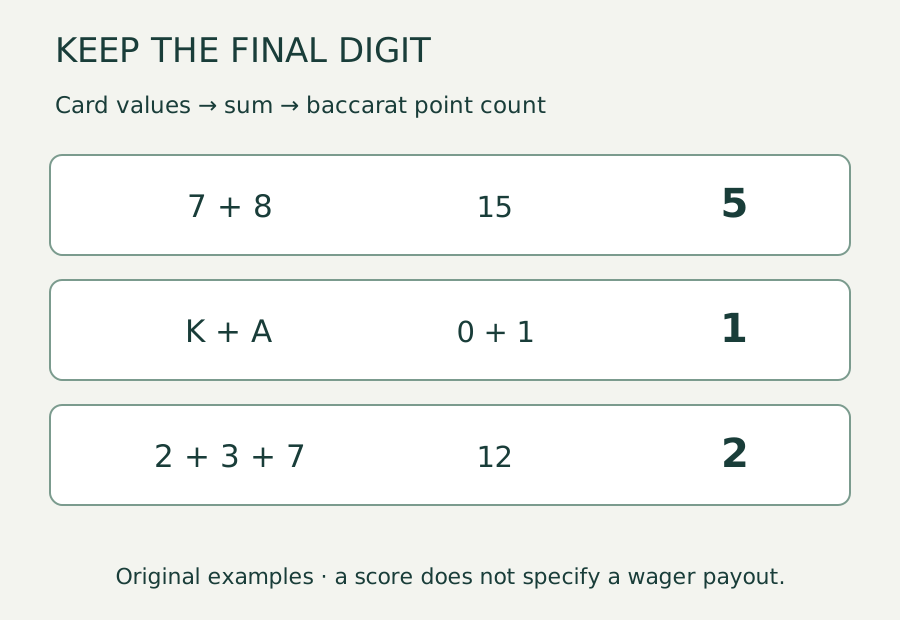
How does online baccarat work? Scoring, third cards and settlement
Follow seven worked baccarat cases to separate card values, automatic drawing rules, hand labels and the payout conditions of a particular variant.
Read How does online baccarat work? Scoring, third cards and settlement
Continue reading
Baccarat roads record results without revealing the next hand
Separate Bead and Big Road results from derived roads. Recount a twelve-round example and see why a winner label cannot reconstruct the remaining shoe.
Read Baccarat roads record results without revealing the next handA baccarat tie settles three betting positions differently
A Tie pays its own wager but returns ordinary Player and Banker stakes. Check £10 payouts, a mixed £22 example and the difference between profit and return.
Read A baccarat tie settles three betting positions differentlyPlayer and Banker are names for hands
In a baccarat explanation, Player and Banker identify two hands.
Read Player and Banker are names for handsPlayer and Banker are names for hands
Should you bet Banker or Player in baccarat? What the 5% commission really changes
The third-card rules of the card game baccarat, and the odds they produce
Baccarat roads record results without revealing the next hand
A baccarat tie settles three betting positions differently
How does online baccarat work? Scoring, third cards and settlement