Core guide
How does online baccarat work? Scoring, third cards and settlement
Follow seven worked baccarat cases to separate card values, automatic drawing rules, hand labels and the payout conditions of a particular variant.
Case one: the larger card sum can produce the smaller score
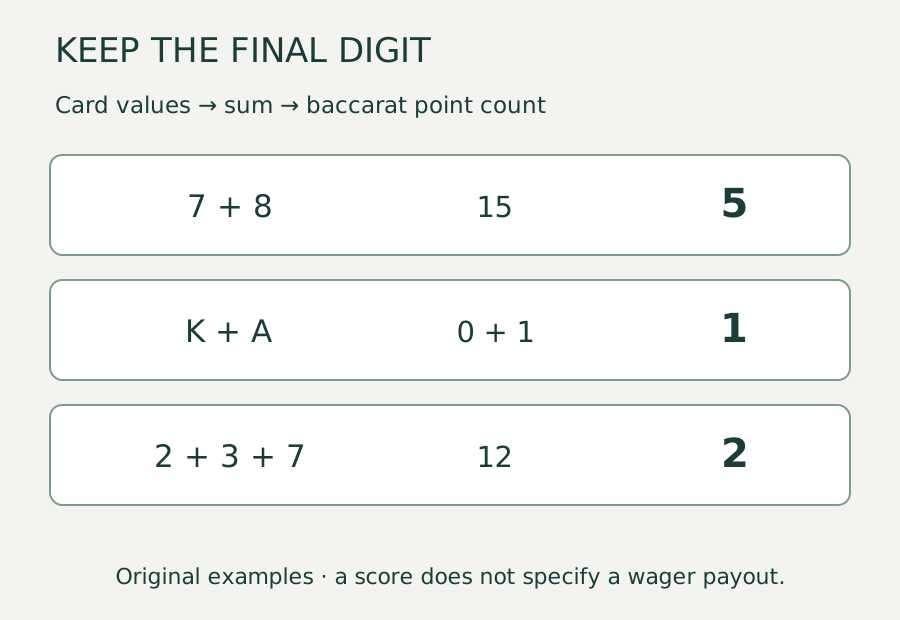
Seven and eight add to fifteen, but their baccarat point count is five. The scoring operation keeps the final digit. A king and an ace have values zero and one, producing a point count of one. This differs from blackjack, so importing an ace’s eleven-point value would make the explanation wrong from the first step.
The reference model uses face values for two through nine, zero for tens and picture cards, and one for aces. A hand’s final point count lies from zero to nine. The original diagram shows selected sums rather than a real round or an operator screenshot.
For a three-card arithmetic example, two plus three plus seven equals twelve, giving a point count of two. A third card therefore need not increase the displayed point count. The arithmetic wraps through ten; the apparent drop is not evidence that the system has subtracted a penalty.
This guide uses the Massachusetts regulator’s published rules as an explicit comparative model. An online variant’s own rules remain the relevant source for that game. We have not tested a casino or recorded a playing session for these examples.
Case two: Player and Banker are names on the table
Player and Banker label the two hands in the model. They do not automatically describe the person reading the screen or the company running the casino. Our note on the hand labels explains that vocabulary before any payout comparison.
Imagine a round showing Player five and Banker seven after the required dealing is complete. The scores identify the higher hand, but they do not tell you which wager somebody selected, whether a separate side wager existed or what amount was exposed. A statement such as “I had seven” can obscure those distinctions unless it names the hand and the relevant wager.
A careful explanation can therefore use three separate sentences: the completed hands have these scores; a particular wager concerns this outcome; the applicable rules settle that wager in this way. Combining all three into a single “win” label may conceal a condition the reader needs.
The same principle applies to a tie. Equal completed scores establish a tied hand result in the model. The treatment of the main-hand wagers and any tie wager must be read from the specific game’s settlement rules. Do not infer every credit or debit from the word tie alone.
Case three: an initial natural comes before the drawing table
A natural in the reference model is an initial two-card point count of eight or nine. If either hand has one, neither draws a third card. The word initial matters: a later three-card total of eight is not an initial natural merely because the display shows the same digit.
Use an illustrative pair of initial totals: Player eight and Banker four. The natural condition resolves whether any third cards are drawn before the ordinary drawing sequence is consulted. Applying a “draw on four” instruction without that preliminary check would give the wrong result.
Now compare Player four and Banker five. Neither is a natural, so the normal sequence continues. These examples show why a rule table should be read in order rather than as isolated rows. A row can be correct while being inapplicable because an earlier condition has already ended the process.
The worksheet follows that order explicitly. When a natural is present, it says that the supplied third-card value is ignored. This avoids giving an unused input a misleading role in the answer. It does not create or predict a card; the values are selected teaching inputs.
Case four: when Player stands, the Banker question is simpler
If neither initial hand is natural, Player stands on six or seven in the stated model. When Player stands, Banker draws on an initial total of five or less and stands on six or seven. There is no Player third card to consult in that branch.
For example, initial Player six and Banker five leads to Player standing and Banker drawing. Initial Player seven and Banker six leads to both standing. These are applications of a prescribed dealing sequence, not decisions about which hand deserves a card.
A common reading mistake is to keep searching the Player-third-card column even when no such card exists. The worksheet prevents that confusion in its explanation: it identifies the stand branch and states that the third-card input is ignored.
When reviewing a rules illustration, ask whether the branch condition is visible. A compact chart headed only “Banker draws” may omit the context that makes its rows meaningful. Keep the initial Player total, initial Banker total and the presence or absence of a Player third card together in the worked example.
Case five: the third card’s value is not Player’s final total
When Player draws in the reference model, some Banker decisions depend on the value of that drawn card. They do not use Player’s resulting total as a substitute. The distinction is the main purpose of our interactive rule reader.
Take initial Player four and Banker three, with Player’s third card valued eight. Player’s new point count is two, because four plus eight is twelve. The relevant third-card value is still eight. Under the stated rule, Banker stands on three in that case. Looking up the final Player total of two instead would produce the wrong branch.
Now keep the initial totals but change the third-card value to two. Player finishes on six, and Banker draws. These two cases have the same starting totals but a different relevant third-card input. They show exactly why the worksheet displays both the input value and the resulting total in separate phrases.
The full conditional rule is deliberately confined to the worksheet’s labelled model. It does not cover every optional product carrying the baccarat name. A provider variant that changes the dealing sequence would need its own documented logic; relabelling this tool would not be enough.
Another useful contrast is initial Player five and Banker six. A Player third-card value of six leads Banker to draw; a value of five leads Banker to stand. The difference is one input crossing a specified condition, not the Banker hand making a tactical choice. Writing both examples side by side exposes the relevant boundary more clearly than presenting only a single successful lookup.
Select initial totals and the Player third-card value to read the applicable drawing branch.
Case six: commission changes money, not the displayed point count
Suppose a hypothetical winning Banker wager has a £10 stake, pays one-to-one profit and deducts a commission equal to 5% of that profit, with no additional rounding. The profit before commission is £10; the commission is 50p; net profit is £9.50. If the stake is returned as well, the gross amount returned is £19.50.
This is an expressly defined arithmetic example. It does not establish an online casino’s current commission, rounding method or settlement timing. Those conditions need the game’s own rules. Our focused commission explanation shows why a single percentage is only one line of a complete comparison.
Nor does a “no commission” label establish that every other payout condition is identical. A variant can have a different exception or treatment of a specified outcome. Read the full relevant condition instead of assuming that removal of one charge leaves the remainder unchanged.
The example does not calculate the probability of a winning Banker hand or the house edge. Calculating a deduction on a known illustrative win and modelling the distribution of all possible rounds are different tasks. Keeping them separate prevents a small correct sum from being promoted into an unsupported claim about the whole game.
Case seven: a complete explanation needs the game and the round stage
Before applying a rule to an online display, identify the exact game and whether the cards shown are initial or final. A screenshot taken mid-round can support a description of what was visible at that moment. It may not support a statement about the completed result or the account settlement.
The UK remote standards address relevant rules and payout information, while result determination concerns processing under the applicable published rules. For a specific question, that means finding the actual game explanation and the relevant round record rather than borrowing a rule from a similarly named product.
A useful record contains the title, source address, access date and precise condition being explained. Separate your own arithmetic from the source’s rule. If a branded game’s full rules are inaccessible, leave its variant conditions unresolved; do not invent a review score or claim that a session was tested.
The illustrations on this page are original educational material and the worksheet runs locally with selected inputs. Together they show how to read the sequence: score the initial hands, check the natural condition, follow the applicable drawing branch, then consult the relevant settlement rules. That order makes a complicated-looking table understandable without suggesting that the reader can choose or forecast the dealt cards.
Sources: UK Gambling Commission: RTS 3 — Rules and game information; UK Gambling Commission: RTS 5 — Result determination.
Questions answered
Why does seven plus eight make five in baccarat?
The card values sum to fifteen and the point count keeps the final digit, five. This is baccarat scoring, not subtraction caused by a penalty.
Does Banker always draw on three?
Not in the stated drawing model. When Player has drawn a third card valued eight, Banker stands on three. Initial naturals and the Player-stand branch must also be checked in order.
Does the third-card worksheet choose a bet?
No. It explains a prescribed dealing rule from selected point values. It neither generates cards nor recommends, places or settles a wager.