Facts checked Article
Baccarat education
A baccarat tie settles three betting positions differently
A Tie pays its own wager but returns ordinary Player and Banker stakes. Check £10 payouts, a mixed £22 example and the difference between profit and return.
Equal totals do not make every wager a winner
When the final Player and Banker totals are equal, an ordinary Tie wager wins while the main Player and Banker wagers push under the rules examined here. A push returns the stake without profit. The same dealt result can therefore produce a paid win for one selection and merely return the money attached to another.
The Massachusetts Gaming Commission's baccarat rules distinguish these three positions explicitly. PokerStars' online baccarat pages provide a corresponding public example, including an 8:1 Tie payout. These sources establish documented settlements; they do not establish the rules of every product using baccarat in its name.
No table was played or account inspected for this note.
The reader task is deliberately narrow: reconcile a Tie result with the amount returned, including situations where more than one permitted position was staked. The examples use ordinary commission baccarat, a 5% deduction from winning Banker profit and an 8:1 Tie payout. They do not model enhanced ties, multiplier features or commission-free exceptions.
Sources: Baccarat rules, 11 April 2024; Live Baccarat Rules - Baccarat FAQs; How to Play Baccarat.
The tie — three positions, three settlements
- A Tie result
- When the final Player and Banker totals are equal, an ordinary Tie wager wins while the main Player and Banker wagers push under the rules examined here.Baccarat rules, 11 April 2024 · as checked on
- What a push returns
- The stake without profit. The same dealt result can produce a paid win for one selection and merely return the money attached to another.Baccarat rules, 11 April 2024 · as checked on
- The public example
- PokerStars' online baccarat pages provide a corresponding public example, including an 8:1 Tie payout.Live Baccarat Rules - Baccarat FAQs · as checked on
- Assumptions in the ledger
- Ordinary commission baccarat, a 5% deduction from winning Banker profit and an 8:1 Tie payout. Enhanced ties, multiplier features and commission-free exceptions are not modelled.How to Play Baccarat · as checked on
- What was not done
- No table was played or account inspected for this note.Baccarat rules, 11 April 2024 · as checked on
These sources establish documented settlements; they do not establish the rules of every product using baccarat in its name.
Put three meanings in three columns
Keep the result label, the selected betting position and the financial settlement separate. Tie can be the result label even when nobody has placed a Tie wager. Conversely, selecting Tie does not give a return whenever either main hand receives a particular attractive total.
It needs equality between the completed point totals under the stated rules.
For a simple illustration, completed totals of 7 and 7 meet that equality condition. Completed totals of 7 and 6 do not. The figures are hypothetical final scores, not a proposed dealing sequence; a complete card sequence would also have to obey the drawing procedure.
This article starts after that procedure has produced the final hands.
Do not confuse a pair of equal-ranked cards within one hand with equal final totals across the two hands. PokerStars lists Pair wagers separately from its main result bets. A Pair label and a Tie label therefore refer to different conditions.
Our ledger does not include Pair wagers. Keeping them out makes the scope visible instead of treating every side-bet payment as evidence about a main-hand tie.
Sources: Baccarat rules, 11 April 2024; Live Baccarat Rules - Baccarat FAQs.
Three words, three meanings
- Result label
- The name the round's outcome receives once the hands are complete: Player, Banker or Tie, whether or not anyone staked on it.
- Betting position
- The selection a customer actually placed money on; Tie can be the result label when nobody selected Tie.
- Push
- A returned stake with no profit; the main-hand wagers push when the completed totals are equal.
- Settlement
- The money returned on each position once the result is known, kept separate from the result label.
- Paytable
- The stated payout for each position, such as 8:1 on Tie; it says how a winning stake is paid, not how often the result occurs.
- Pair wager
- A separate side bet on equal-ranked cards within one hand; it is not a Tie and sits outside this ledger.
- Commission
- The 5% deduction from winning Banker profit in ordinary commission baccarat.
A £10 stake shows what 8:1 includes
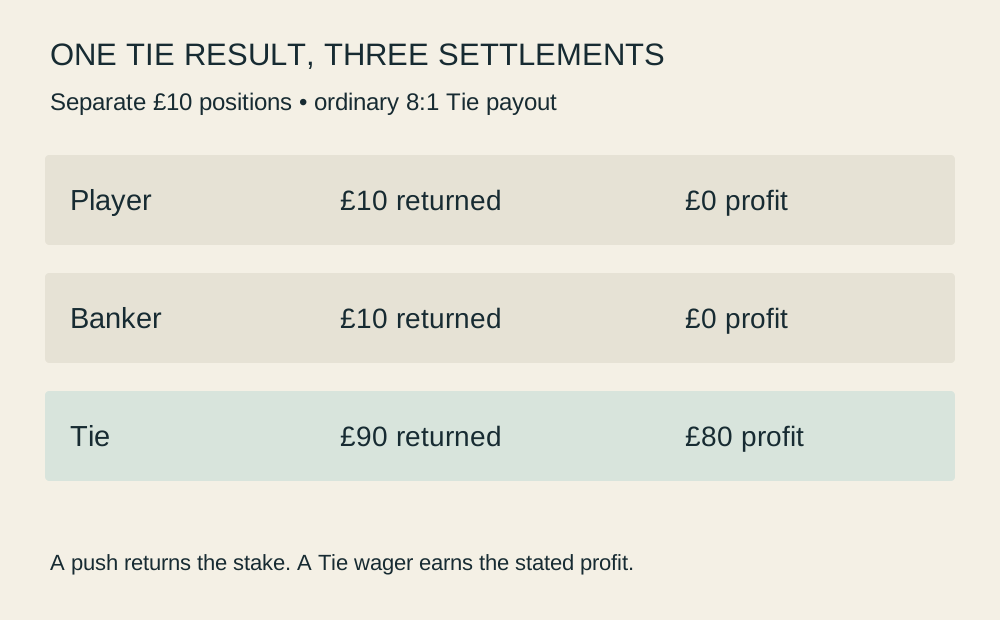
A winning £10 Tie wager at 8:1 earns £80 profit and returns the original £10. Total money returned is £90. Eight times the stake calculates profit; nine times the stake calculates the gross return in this particular settlement.
Calling both numbers winnings makes the record unnecessarily ambiguous.
Now compare a £10 main-hand wager when the round ties. It returns £10 with zero profit. That is a different settlement, even though both accounts might show a credit after the round.
The size and basis of the credit identify what happened; the mere presence of a credit does not.
These are alternative single-position examples. Adding the three returns would require adding the three stakes too, and permission to place that combination. The table is an explanatory ledger, not a representation of controls available at a named online table.
| Separate £10 position | Result is a tie | Gross return | Net result |
|---|---|---|---|
| Player | Push | £10 | £0 |
| Banker | Push | £10 | £0 |
| Tie at 8:1 | Paid win | £90 | +£80 |
Sources: How to Play Baccarat.
Follow a mixed wager through every result
To see why total commitment matters, construct a second example with £20 on Banker and £2 on Tie, assuming that combination is permitted. Total stake is £22. The stake sizes are invented for clear arithmetic; they are not a recommendation or a record of play.
If Banker wins under the stated commission rule, the £20 main wager earns £19 net profit and returns its £20 stake. The £2 Tie wager loses. Gross return is £39 and combined profit is £17, calculated as £39 minus £22.
Quoting only the £19 Banker profit omits the other position's cost.
If Player wins, both selected positions lose and the net result is minus £22. If the round ties, the Banker position returns £20 and the Tie position returns £18: £16 profit plus the £2 stake. Gross return is £38, making combined profit £16.
No probabilities have been assigned to these rows. They are settlement branches, not a three-outcome model with equal chances. The table cannot establish a likely session result by taking an unweighted average of its last column.
| Final result | Banker return | Tie return | Total return | Net after £22 |
|---|---|---|---|---|
| Banker wins | £39 | £0 | £39 | +£17 |
| Player wins | £0 | £0 | £0 | −£22 |
| Tie | £20 | £18 | £38 | +£16 |
Sources: How to Play Baccarat.
A larger payout is not the frequency of the event
The payout ratio answers how a successful Tie stake is paid. It does not answer how often a tie occurs. Those are separate inputs, and the difference can be shown without importing an unsourced probability for a particular table.
Let p represent the probability of a tie under a specified model. On a £1 Tie wager paying 8:1, the theoretical net return is £8 when it wins and minus £1 when it loses. The weighted expression is 8p − (1 − p), which simplifies to 9p − 1.
It reaches zero when p is 1/9, about 11.111%. That is the break-even probability required by this payout, not the observed or calculated tie frequency of any game.
For a hypothetical 9:1 net payout, the expression would instead be 10p − 1, requiring p = 1/10, or 10%. This second calculation changes the payout input only. We have not verified a currently available UK table offering it, and do not suggest that changing a displayed ratio changes the dealing procedure.
The distinction also prevents a misleading reading of nine for one. If a rule uses that phrase to include the returned stake, it describes £9 total for £1 staked, matching an 8:1 profit payout. Establish the author's convention before translating a ratio into an amount.
Our examples use to-one profit ratios consistently.
Sources: How to Play Baccarat.
Break-even probability — two payout inputs, one method
| Tie payout, to-one profit | Weighted expression | Break-even p | As a percentage | Evidence |
|---|---|---|---|---|
| 8:1, as in the cited example | 9p − 1 | 1/9 | about 11.111% | · How to Play Baccarat |
| 9:1, hypothetical | 10p − 1 | 1/10 | 10% | · How to Play Baccarat |
A break-even probability is the threshold the payout requires, not the observed or calculated tie frequency of any game. No check was made for a currently available UK table offering the hypothetical ratio.
A result record has limits
A road or recent-results entry marked Tie establishes, at most, the recorded result label for that round. It does not identify a particular customer's accepted selections, stake amounts or credited returns. Two people observing the same result could have completely different financial records because they selected different positions or did not participate.
For a settlement check, pair the named round with the accepted bets and the applicable paytable. Write stake, gross return and net result as separate fields. If the history says £18 paid on a £2 Tie stake at 8:1, the arithmetic is consistent with £16 profit plus stake.
If it says £16, first determine whether the field reports profit rather than gross return before declaring a discrepancy.
An account balance can be even less specific. It may include other rounds or a returned stake recorded separately. The calculations here assume one completed round with no unrelated movement.
That assumption belongs beside the example, especially when several betting positions settle together. A missing transaction field cannot be reconstructed from the score alone.
Never use a sequence of Tie labels to invent a personal entitlement to the next one. Nothing in the settlement ledger supplies the remaining composition of a shoe, the next cards or a probability forecast.
How to check a Tie settlement against the record
The settlement check the prose above describes. It can be followed on paper without staking money.
Name the round
Pair the named round with the accepted bets and the applicable paytable, not with a road entry alone.
Write three separate fields
Record stake, gross return and net result as separate fields for each position selected.
Test the arithmetic
If the history says £18 paid on a £2 Tie stake at 8:1, the arithmetic is consistent with £16 profit plus stake.
Identify the field before disputing it
If it says £16, first determine whether the field reports profit rather than gross return before declaring a discrepancy.
Isolate the round
The calculations assume one completed round with no unrelated movement. An account balance may include other rounds or a returned stake recorded separately.
What the result means
A consistent set of fields explains the completed outcome for the positions selected. It supplies nothing about the next cards, the remaining shoe or a probability forecast.
Read the exception before applying the ledger
The method survives a variant change, but the numbers may not. An enhanced Tie, a total-specific Tie market, a fee or a different Banker settlement requires its own row definitions and payouts. A product name containing baccarat is not sufficient evidence that all three branches above remain valid.
The practical rule note should therefore include the full game name, the specific Tie selection, its ratio convention, the main-hand treatment on equality, any commission and the source date. Preserve distinctions between an operator's short overview and the detailed in-game rules.
If they disagree, the safe editorial conclusion is that the discrepancy remains unresolved; it is not permission to choose whichever version makes the example more attractive.
This study provides an original settlement comparison, not a ranking of bets or operators. It deliberately makes no session-return claim and no claim that a Tie wager insures a main wager against every loss: in the mixed example, a Player win loses both stakes. A reader can check that result on paper without staking money.
The sources were checked on 19 September 2026. The figure is an original diagram of the three single-position returns, not a screenshot of a live result. Accurate accounting explains a completed outcome; it does not turn chance into a controllable source of income.
Gambling can cause harm.
Sources: Baccarat rules, 11 April 2024; How to Play Baccarat.
The practical rule note — fields to record before applying the ledger
A product name containing baccarat is not sufficient evidence that all three branches remain valid. An enhanced Tie, a total-specific Tie market, a fee or a different Banker settlement needs its own row definitions and payouts.
Ticks are kept only in this browser and are never sent anywhere.
Questions answered
What happens if there is a tie in baccarat?
Under the ordinary rules examined here, Player and Banker wagers push, returning their stakes, while a separately placed Tie wager pays its stated odds. At 8:1, £10 on Tie returns £90 including stake.
What are the basic rules of baccarat?
Player and Banker identify competing hands. This note concerns their final settlement: unequal totals produce a main-hand winner, while equal final totals produce a Tie; fixed drawing rules determine the completed hands.
Is baccarat actually 50/50?
It cannot be described as a two-outcome coin toss because a Tie is a separate result and has its own settlement. Our break-even calculations are payout thresholds, not estimates of the frequency of each result.
Is baccarat a skill or luck?
The cited ordinary game uses prescribed drawing rules rather than a player choice of whether the next card is favourable. Understanding the paytable helps interpret money returned, but cannot guarantee an outcome.
Why does 8:1 return £90 on a £10 Tie stake?
Eight times the stake calculates the profit, £80, and the original £10 is returned with it, so total money returned is £90. Nine times the stake calculates the gross return in this particular settlement.
Does a Tie wager protect a Banker stake against every loss?
No. In the mixed example of £20 on Banker and £2 on Tie, a Player win loses both stakes and the net result is minus £22.
Is a Pair wager the same as a Tie?
No. A Pair label refers to equal-ranked cards within one hand, while a Tie needs equal final totals across the two hands. PokerStars lists Pair wagers separately from its main result bets, and this ledger leaves them out.
Original rules
Continue reading
Player and Banker are names for hands
In a baccarat explanation, Player and Banker identify two hands.
Read Player and Banker are names for hands
Should you bet Banker or Player in baccarat? What the 5% commission really changes
Neither bet wins over time. With 5% commission on eight decks, Banker costs 1.06p per £1 on average and Player 1.24p. The commission is one clause; the rest of the rules decide the rest.
Read Should you bet Banker or Player in baccarat? What the 5% commission really changes
Baccarat roads record results without revealing the next hand
Separate Bead and Big Road results from derived roads. Recount a twelve-round example and see why a winner label cannot reconstruct the remaining shoe.
Read Baccarat roads record results without revealing the next hand
When does the banker draw a third card in baccarat?: the rule, the totals, and the exact odds
Banker draws a third card by a fixed table: on 0 to 5 if Player stood, and by Player’s third card on 3 to 6 if Player drew. Every row, its frequency over eight decks, and the cost per £10.
Read When does the banker draw a third card in baccarat?: the rule, the totals, and the exact odds
The third-card rules of the card game baccarat, and the odds they produce
Every Player and Banker total in the card game baccarat, every third-card case, and the exact Banker, Player and Tie probabilities the rules produce over eight decks.
Read The third-card rules of the card game baccarat, and the odds they produce
How does online baccarat work? Scoring, third cards and settlement
Follow seven worked baccarat cases to separate card values, automatic drawing rules, hand labels and the payout conditions of a particular variant.
Read How does online baccarat work? Scoring, third cards and settlement
Continue reading
When does the banker draw a third card in baccarat?: the rule, the totals, and the exact odds
Banker draws a third card by a fixed table: on 0 to 5 if Player stood, and by Player’s third card on 3 to 6 if Player drew. Every row, its frequency over eight decks, and the cost per £10.
Read When does the banker draw a third card in baccarat?: the rule, the totals, and the exact oddsBaccarat roads record results without revealing the next hand
Separate Bead and Big Road results from derived roads. Recount a twelve-round example and see why a winner label cannot reconstruct the remaining shoe.
Read Baccarat roads record results without revealing the next handPlayer and Banker are names for hands
In a baccarat explanation, Player and Banker identify two hands.
Read Player and Banker are names for handsPlayer and Banker are names for hands
Should you bet Banker or Player in baccarat? What the 5% commission really changes
The third-card rules of the card game baccarat, and the odds they produce
Baccarat roads record results without revealing the next hand
How does online baccarat work? Scoring, third cards and settlement
When does the banker draw a third card in baccarat?: the rule, the totals, and the exact odds