Facts checked Article
Baccarat education
Should you bet Banker or Player in baccarat? What the 5% commission really changes
Neither bet wins over time. With 5% commission on eight decks, Banker costs 1.06p per £1 on average and Player 1.24p. The commission is one clause; the rest of the rules decide the rest.
Should you bet Banker or Player in baccarat? The short answer
Should you bet Banker or Player in baccarat? Neither bet wins over time, and the rules say by how much each one costs.
With 5% commission on eight decks, Banker costs 1.06p per £1 staked on average. Player costs 1.24p.
That gap is small. At £20 a hand for 100 hands it comes to £3.54.
An independent-hand approximation puts one standard deviation at roughly £185 to £190; that measures spread, not a limit on losses. So the commission line is worth reading, but it does not turn either bet into a good one.
The commission is also only one line of the rules. A table that drops it adds a different clause somewhere else. This page works through one payout, the two edges, the no-commission clause and the tie, all in pounds.
Sources: Massachusetts Gaming Commission: baccarat rules.
The figures this page works with
- Banker win
- Paid at 1 to 1, less a commission of 5% of the amount won.Massachusetts Gaming Commission: baccarat rules · as checked on
- Player win
- Paid at 1 to 1, with no commission.Massachusetts Gaming Commission: baccarat rules · as checked on
- Tie wager
- Paid at odds of at least 8 to 1.Massachusetts Gaming Commission: baccarat rules · as checked on
- Average cost per £1
- Banker 1.06p, Player 1.24p, Tie at 8 to 1 14.36p.Massachusetts Gaming Commission: baccarat rules · as checked on
Rule text read on 23 September 2026. Edges are our own exact enumeration of the published drawing rules over eight decks.
One £20 Banker win, settled line by line
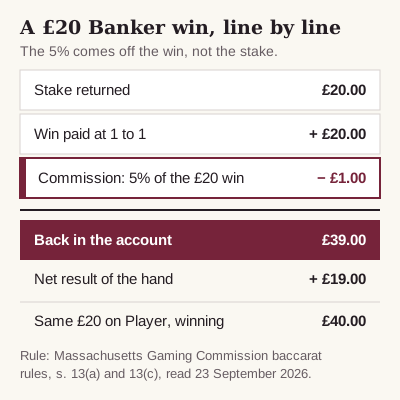
Take one eligible Banker win at even money with exactly 5% taken from the winnings. A £20 stake produces £20 of gross winnings. The commission is £1, so the net profit is £19.
The returned stake is a separate £20. So £39 comes back to the account in total. The same £20 on a winning Player bet returns £40, because Player wins carry no commission.
The Massachusetts Gaming Commission rules set this out in plain terms. A Banker win is paid at odds of 1 to 1, and the licensee takes a commission equal to 5% of the amount won. The fee comes off the win, never off the stake.
Banker acts second, so its wins carry the 5%
The commission exists because the Banker hand acts second. It draws or stands after it has seen what the Player hand did. That small advantage makes Banker win more often.
Over eight decks, Banker wins 45.86% of hands and Player wins 44.62%. The other 9.52% are ties, which return both main stakes. We reproduced those figures by counting every possible deal from a 416-card shoe.
Without a fee, a Banker bet would gain about 1.24p per £1 on average. Taking 5% of each Banker win costs the bettor 2.29p per £1. The result is an average loss of 1.06p per £1, so the house keeps a small edge on both main bets.
Banker, Player and Tie: the three edges side by side
The table below puts the three wagers in one place. Each row uses the same eight-deck shoe and the payouts in the Massachusetts rules.
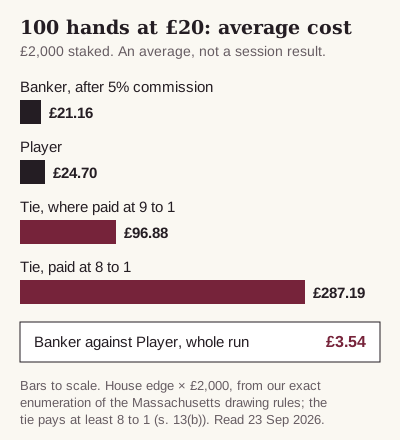
Read the last column first. It shows what 100 hands at £20 cost on average, which is £2,000 staked in all. Banker costs £21.16 and Player £24.70.
The tie is the outlier. At 8 to 1 it costs £287.19 on the same run, more than 13 times the Banker figure. The tie section below explains why.
Sources: Massachusetts Gaming Commission: baccarat rules.
What each baccarat bet costs, eight decks
| Wager | Wins on | Pays | House edge | Average cost of 100 hands at £20 | Evidence |
|---|---|---|---|---|---|
| Banker | 45.86% of hands | 1 to 1 less 5% commission | 1.06% | £21.16 | · Massachusetts Gaming Commission: baccarat rules |
| Player | 44.62% of hands | 1 to 1 | 1.24% | £24.70 | · Massachusetts Gaming Commission: baccarat rules |
| Tie | 9.52% of hands | 8 to 1 | 14.36% | £287.19 | · Massachusetts Gaming Commission: baccarat rules |
Every figure is an average over very many hands. None of them is a forecast of a session.
What 0.18p per pound looks like over an evening
The gap between the two main bets is 0.18p per £1. Over 100 hands at £20 it adds up to £3.54. That is the net expected-cost gap between the two bets after commission.
Now set it beside the spread. Treating 100 hands as independent repetitions at unchanged full-shoe probabilities gives a standard deviation of about £185 on Banker and £190 on Player, at £20 per hand.
We calculate each one as the one-hand standard deviation multiplied by £20 and the square root of 100. This is an approximation for comparison, not an exact model of a shoe dealt without replacement. Results can fall much further from the average; neither figure is a loss limit.
So a good evening on Banker does not show that Banker was the right call. A bad evening on Player does not show it was wrong. Both bets have a negative average, and choosing not to bet is the only option that costs nothing.
Try your own stake: the average cost of a run
Enter a stake per hand, the number of hands and the house edge of the wager. The tool gives the total staked and the average cost of the run.
Worked example: with stake per hand £20.00, number of hands 100, house edge of the wager 1.06%, total staked is £2,000.00 and average cost of the run is £21.20. Banker at £20 a hand for 100 hands, with 5% commission on eight decks: an average cost of £21.20 at the rounded 1.06% (our unrounded figure is £21.16).
Use 1.06 for Banker with 5% commission, 1.24 for Player and 14.36 for a tie at 8 to 1, all on eight decks. It is an average, not a prediction of any session.
A no-commission table has a different clause, not no clause
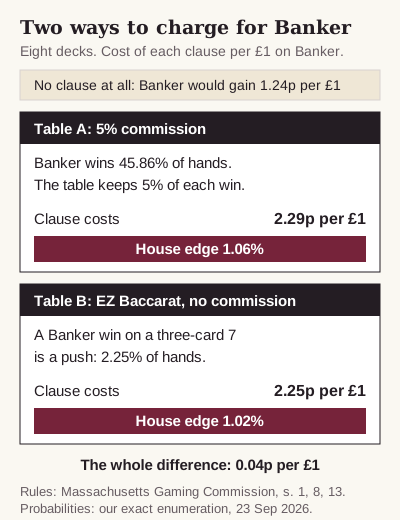
A commission-free label should prompt a second question: what changes elsewhere? The Massachusetts rules describe EZ Baccarat as a variation in which the commission is not collected. In its place, one Banker outcome returns the stake instead of paying a win.
That outcome is the Dragon 7. The rules define it as a Banker hand with a point count of 7 on three cards, against a Player hand below 7. When it happens, the Banker wager is returned as a push.
On eight decks a Dragon 7 comes up on 2.25% of hands. Losing those wins costs 2.25p per £1 staked on Banker, against 2.29p for the 5% commission. The house edge moves from 1.06% to 1.02%, a difference of 0.04p per £1.
That is an example of why deleting one fee line does not by itself describe the whole game. Here the swap happens to be close. Another table could swap in a clause that costs more, and only the rules page would show it.
Check the rounding line as well
The commission clause can carry a rounding rule. The Massachusetts rules let the licensee round the commission up to 25 cents or the next multiple of 25 cents. On a small win that can mean more than 5%.
Our £20 example assumes no rounding at all. Whether a particular online game rounds is a line to look for in its own rules. We did not check any operator game for this page.
The tie at 8 to 1 costs 14.36p per £1
The tie wager wins on 9.52% of hands on eight decks. The Massachusetts rules set its payout at odds of at least 8 to 1. At 8 to 1 the house edge is 14.36%, or 14.36p per £1 staked.
A table that pays 9 to 1 cuts that edge to 4.84%. The payout line, not the frequency, is what moves the cost. So the tie is the line to read most carefully, and the one where commission plays no part.
A tie also returns both main stakes. A £20 Banker or Player bet comes back whole, and nothing is won or lost on it.
A road is a record, not a forecast. If following one has cost more than intended, GamCare's helpline is 0808 8020 133.
Sources: Massachusetts Gaming Commission: baccarat rules; GamCare.
How to compare two baccarat tables line by line
Build a comparison using settlement examples under each variant's written conditions. Record how ordinary wins, the named exception and ties are handled. The steps below keep the comparison narrow and honest.
Do not announce a better overall return from the commission line alone. An overall figure needs the complete rules and probabilities, while a single example shows only its own settlement.
Compare two tables in four steps
Use the same £20 stake on both tables so the figures line up.
Settle an ordinary Banker win
Write down what £20 returns on each table. With 5% commission it is £39 in total; with no commission it is £40.
Find the named exception
Look for the clause that replaces the commission, such as a Banker three-card 7 that pushes. Write down when it applies.
Settle a tie
Check that a tie returns Player and Banker stakes whole, and write down the tie payout: 8 to 1, 9 to 1 or something else.
What the result means
You now know how each table settles. An overall edge needs the full rules and the probabilities; one example cannot give it.
What a rules page must show before you stake
For a game offered to customers in Great Britain, you should be able to read all of this before you bet. The Gambling Commission's technical standard RTS 3 says an explanation of the rules must be easily available before a customer commits to gamble.
The same standard asks for the house edge, the return to player or the chance of winning, and for the payouts or how they are worked out. So the commission, the clause that replaces it and the tie payout should all be findable.
RTS 3 describes the information requirement; it does not prescribe these particular baccarat payouts. A different variant needs its own disclosed rules. Disclosure alone does not establish compliance with every other requirement.
Sources: Gambling Commission: RTS 3.
The Gambling Commission on rules pages
An explanation of the applicable rules must be easily available to the customer before they commit to gamble.
Five lines to find on a baccarat rules page
Each line maps to the rules or to RTS 3, read on 23 September 2026. Ticks stay in your browser.
- A house edge, return to player or chance of winning for each wager. If you cannot find these before you stake, you can leave the game unplayed.
Ticks are kept only in this browser and are never sent anywhere.
What the commission line does not tell you
It does not tell you who wins the next hand. The drawing rules decide every card, and no bet changes them. A run of result labels does not reveal the remaining cards or establish that the next result is due.
It does not make Banker a good bet. It makes Banker slightly less costly than Player on a standard table, and that is all. Casino games are priced to keep a share of what is staked; short-term wins do not make them a dependable source of income.
For the full drawing rules behind these figures, and the odds they produce, see the third-card rules. That page is the reference this note returns to.
The words on this page
- Banker
- The name of one of the two hands dealt in baccarat, not a person and not the casino. Player is the other hand.
- Commission
- The 5% taken from a winning Banker wager. The Massachusetts rules call it vigorish.
- House edge
- The average share of each stake a game keeps over very many hands. Here it is 1.06% on Banker and 1.24% on Player.
- Push
- A result where the stake comes back and nothing is won or lost.
- Dragon 7
- In EZ Baccarat, a Banker win on a three-card 7 against a lower Player hand. The Banker wager pushes instead of being paid.
- Eight decks
- A shoe of 416 cards. Every figure on this page assumes one.
- RTS 3
- The Gambling Commission remote technical standard on rules, game descriptions and the likelihood of winning.
- Settlement
- How a finished hand is paid: what comes back on each wager, and what is kept.
- Standard deviation
- A measure of how widely results spread around their average. Here it is calculated for independent hands at unchanged probabilities; it is not a maximum possible loss.
Sources checked 24 September 2026
All three cited pages were reopened on 24 September 2026. The Massachusetts Gaming Commission baccarat rules supplied the payouts, the commission, the rounding clause and the EZ Baccarat definitions. RTS 3 supplied what a rules page must show.
GamCare's own site supplied the helpline number.
The probabilities were independently reproduced from the published drawing rules for a complete eight-deck shoe. Costs use those probabilities; the session spread additionally assumes independent repetitions at unchanged probabilities.
These are calculations, not operator measurements. We did not place any bet to write this page.
Sources: Massachusetts Gaming Commission: baccarat rules; Gambling Commission: RTS 3; GamCare.
Questions answered
Should you bet Banker or Player in baccarat?
Both bets have a negative expected return. On a standard eight-deck table with 5% commission, Banker costs 1.06p per £1 on average and Player 1.24p. The expected-cost gap over 100 hands at £20 is £3.54. Actual results can differ greatly from those averages.
Why is there a commission on Banker bets?
Because the Banker hand acts second and wins slightly more often: 45.86% of hands against 44.62% for Player on eight decks. Taking 5% of each Banker win turns an average gain of about 1.24p per £1 into a loss of 1.06p.
Is no-commission baccarat cheaper?
Not by the label alone. EZ Baccarat drops the commission but pushes a Banker win on a three-card 7, which gives a Banker house edge of 1.02% against 1.06% with commission. Other clauses can cost more, so read the rules page.
How much commission is taken on a £20 Banker win?
£1, which is 5% of the £20 won. The stake comes back separately, so £39 is returned in total and the net profit is £19.
Does the commission apply to a tie?
No. A tie returns both Player and Banker stakes whole. The tie wager itself is paid at odds of at least 8 to 1 under the Massachusetts rules, with no commission.
Original rules
Continue reading
Player and Banker are names for hands
In a baccarat explanation, Player and Banker identify two hands.
Read Player and Banker are names for hands
Baccarat roads record results without revealing the next hand
Separate Bead and Big Road results from derived roads. Recount a twelve-round example and see why a winner label cannot reconstruct the remaining shoe.
Read Baccarat roads record results without revealing the next hand
A baccarat tie settles three betting positions differently
A Tie pays its own wager but returns ordinary Player and Banker stakes. Check £10 payouts, a mixed £22 example and the difference between profit and return.
Read A baccarat tie settles three betting positions differently
When does the banker draw a third card in baccarat?: the rule, the totals, and the exact odds
Banker draws a third card by a fixed table: on 0 to 5 if Player stood, and by Player’s third card on 3 to 6 if Player drew. Every row, its frequency over eight decks, and the cost per £10.
Read When does the banker draw a third card in baccarat?: the rule, the totals, and the exact odds
The third-card rules of the card game baccarat, and the odds they produce
Every Player and Banker total in the card game baccarat, every third-card case, and the exact Banker, Player and Tie probabilities the rules produce over eight decks.
Read The third-card rules of the card game baccarat, and the odds they produce
How does online baccarat work? Scoring, third cards and settlement
Follow seven worked baccarat cases to separate card values, automatic drawing rules, hand labels and the payout conditions of a particular variant.
Read How does online baccarat work? Scoring, third cards and settlement
Continue reading
When does the banker draw a third card in baccarat?: the rule, the totals, and the exact odds
Banker draws a third card by a fixed table: on 0 to 5 if Player stood, and by Player’s third card on 3 to 6 if Player drew. Every row, its frequency over eight decks, and the cost per £10.
Read When does the banker draw a third card in baccarat?: the rule, the totals, and the exact oddsBaccarat roads record results without revealing the next hand
Separate Bead and Big Road results from derived roads. Recount a twelve-round example and see why a winner label cannot reconstruct the remaining shoe.
Read Baccarat roads record results without revealing the next handA baccarat tie settles three betting positions differently
A Tie pays its own wager but returns ordinary Player and Banker stakes. Check £10 payouts, a mixed £22 example and the difference between profit and return.
Read A baccarat tie settles three betting positions differentlyPlayer and Banker are names for hands
The third-card rules of the card game baccarat, and the odds they produce
Baccarat roads record results without revealing the next hand
A baccarat tie settles three betting positions differently
How does online baccarat work? Scoring, third cards and settlement
When does the banker draw a third card in baccarat?: the rule, the totals, and the exact odds