Core guide
The third-card rules of the card game baccarat, and the odds they produce
Every Player and Banker total, every third-card case, and the exact Banker, Player and Tie probabilities those rules generate over eight decks, with the commission arithmetic shown.
The rule that beginner guides leave out
Most explanations of the card game baccarat stop at three sentences: add the cards, keep the last digit, bet on Banker. The part they skip is the reason Banker is the better wager in the first place. Neither hand chooses whether to take a third card. A fixed procedure decides it, and that procedure treats the two hands differently. The Banker hand acts second, with information the Player hand never has, and the small advantage this creates is the entire reason a Banker win pays 95p on the pound rather than a full pound.
This page sets out that procedure in full. The rule text comes from two published sources: the Massachusetts Gaming Commission's baccarat rules of 11 April 2024, which set the drawing rules out as regulation with numbered sections, and the Wizard of Odds baccarat page, which prints the same rules alongside the probabilities they produce for one, six and eight decks. The two documents agree on every line of the drawing rule.
The probabilities in part six are the Wizard of Odds figures for eight decks. We did not take them on trust. A short script written for this page enumerated every possible sequence of four, five and six cards from a 416-card shoe, weighted by its probability, and applied the drawing rules to each. It produced 0.458597, 0.446247 and 0.095156, the same six decimal places the published table shows. Anyone with a spreadsheet or a few lines of code can repeat that; the method is described where the numbers appear.
The rules here are those of punto banco, the version dealt in British casinos and in nearly every online game carrying the name. Chemin de fer and baccarat banque, in which a participant does make drawing choices, are different games and are not covered. If you want the scoring basics first, the seven-case introduction to scoring and settlement walks through them with worked hands; this page is the reference for the drawing rule itself.
Sources: Massachusetts Gaming Commission: Baccarat rules; Wizard of Odds: Baccarat basics.
Card values and naturals come before any drawing decision
The Massachusetts rules put it in one sentence at section 6(a): "Any card from 2 to 9 shall have its face value. Any 10, jack, queen or king shall have a value of zero. Any ace shall have a value of one." Suits do not matter. A hand's point count is the sum of its card values with only the final digit kept, so 7 and 8 make 5, and a king with an ace makes 1.
Two cards go to each hand, dealt alternately, Player first. Before any drawing rule is consulted there is one check. A "natural" is defined as "a hand which has a Point Count of 8 or 9 on the first two cards dealt", and section 11(a) is absolute: "If either the Player's hand or the Banker's hand is a Natural, no more cards may be dealt to either hand." The Wizard of Odds page says the same in plainer words: "If there is at least one natural, then both hands will stand."
The word "either" does work here. A Player 8 against a Banker 3 is over; the Banker does not draw on 3 even though the table below says it would. A Banker 9 against a Player 2 is also over. A natural on one side ends the hand for both sides. Readers who go straight to the drawing table without this check will get those hands wrong, and they are not rare: in an eight-deck shoe, roughly 38% of all hands finish on four cards, most of them because of a natural.
Sources: Massachusetts Gaming Commission: Baccarat rules, ss. 1, 6(a), 11(a).
The Player rule has one line
With no natural on the table, the Player hand is dealt with first and its rule has no conditions. Section 11(b): the Player's hand shall "Draw (take a third card) if the Player's hand has a Point Count of less than 6" and "Stay (not take a third card) if the Player's hand has a Point Count of 6 or more." So a Player total of 0, 1, 2, 3, 4 or 5 takes exactly one more card; 6 or 7 does not. There is no fourth card for either hand under any circumstances.
That one card can move the Player total in either direction. A 5 that draws a 9 becomes 4; a 2 that draws a 6 becomes 8, which is a good hand but not a natural, because the word natural belongs only to the first two cards. Keep hold of the value of the drawn card. The Banker rule in the next section looks at that card, not at the Player's new total, and confusing the two is the single most common misreading of this game.
Sources: Massachusetts Gaming Commission: Baccarat rules, s. 11(b).
The Banker rule has two branches
The Banker rule depends on what the Player hand just did, which is the whole source of the Banker's edge. There are two branches.
If the Player hand stood (on 6 or 7), the Banker hand behaves exactly as the Player did: section 11(c) says the "Banker's hand shall be dealt a third card if the Point Count of the Banker's hand is 5 or less", and stands on 6 or 7. Wizard of Odds phrases it as: "If the Player hand stands with 6 or 7 points, then the Banker hand will draw a third card on a total of 5 or less. Otherwise, with 6 or 7 points, the Banker will stand." In this branch the Banker's decision uses nothing but its own total.
If the Player hand drew, the Banker consults the value of that third card. On a Banker total of 0, 1 or 2 the Banker always draws; on 7 it always stands. On 3, 4, 5 and 6 the answer depends on the card:
- Banker 3 draws unless the Player's third card was an 8.
- Banker 4 draws if the Player's third card was 2, 3, 4, 5, 6 or 7.
- Banker 5 draws if the Player's third card was 4, 5, 6 or 7.
- Banker 6 draws if the Player's third card was 6 or 7.
The pattern is not arbitrary. A Player third card of 2 to 7 tends to have improved the Player hand, so a weak Banker total draws to catch up; a Player third card of 8 or 9 tends to have wrecked it (a 5 drawing a 9 becomes 4), so the Banker keeps a modest total and stands. The odd cell, Banker 3 standing only against an 8, is the one everybody quotes as the exception, and it is where hand-written charts most often go wrong.
Three examples from the same starting position. Player 4 against Banker 3: the Player draws an 8 and now holds 2; the Banker stands on 3, because the card was an 8, and Banker wins 3 to 2. Change the Player's draw to a 2, so the Player holds 6: the Banker draws on 3. Change it to a 9, so the Player holds 3: the Banker draws again, because only an 8 stops a Banker 3, and the hand is then decided by the Banker's card. Same two-card totals, three different procedures.
Sources: Massachusetts Gaming Commission: Baccarat rules, s. 11(c) and Table 1; Wizard of Odds: Baccarat basics.
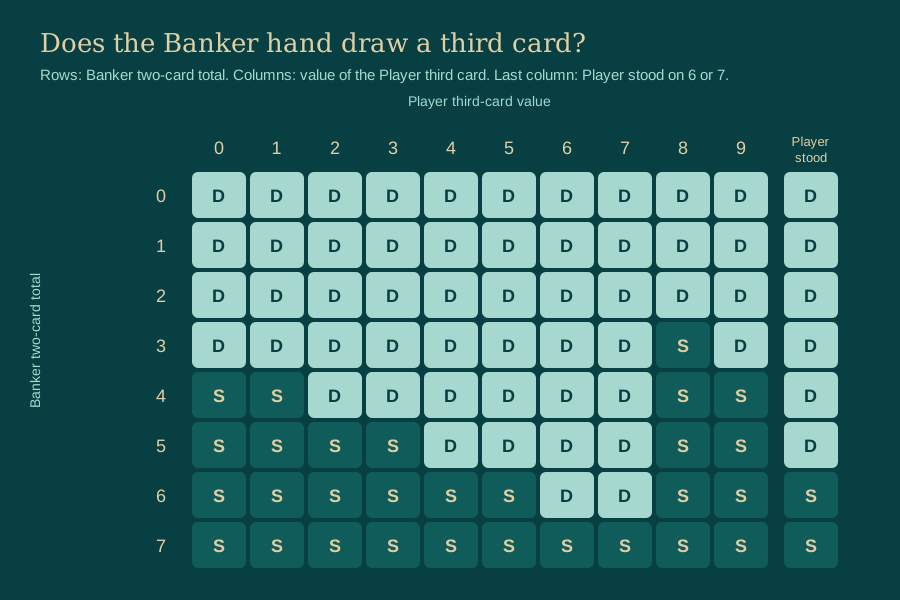
The complete drawing table, total by total
The table below is the whole rule, for every total either hand can hold. It is read top to bottom: check for a natural, apply the Player line, then apply the Banker line that matches what the Player did. Totals of 8 and 9 appear in both halves because a two-card 8 or 9 is a natural and stops play; they are listed so that no total is missing.
| Hand and two-card total | Action if the Player hand stood (6 or 7) | Action if the Player hand drew, by value of that third card |
|---|---|---|
| Player 0, 1, 2, 3, 4, 5 | Draws one card (no natural on either side) | |
| Player 6, 7 | Stands | |
| Player 8, 9 | Natural. No card to either hand | |
| Banker 0 | Draws | Draws on any third card 0–9 |
| Banker 1 | Draws | Draws on any third card 0–9 |
| Banker 2 | Draws | Draws on any third card 0–9 |
| Banker 3 | Draws | Draws on 0, 1, 2, 3, 4, 5, 6, 7, 9 · Stands on 8 |
| Banker 4 | Draws | Draws on 2, 3, 4, 5, 6, 7 · Stands on 0, 1, 8, 9 |
| Banker 5 | Draws | Draws on 4, 5, 6, 7 · Stands on 0, 1, 2, 3, 8, 9 |
| Banker 6 | Stands | Draws on 6, 7 · Stands on 0, 1, 2, 3, 4, 5, 8, 9 |
| Banker 7 | Stands | Stands on any third card |
| Banker 8, 9 | Natural. No card to either hand | |
Two features of the table are worth noticing because they explain the numbers that follow. First, the Banker never draws against a Player who has drawn an 8 or 9 unless the Banker holds 0 to 2 (or 3 against a 9). Second, a Banker 6 that would stand against a standing Player draws if the Player pulled a 6 or 7, because that card has probably taken the Player to a strong total. The Banker is, in effect, reacting to the Player's card. That reaction is worth a little over one percentage point of winning frequency, and the next section counts it.
What the rules produce: Banker, Player and Tie over eight decks
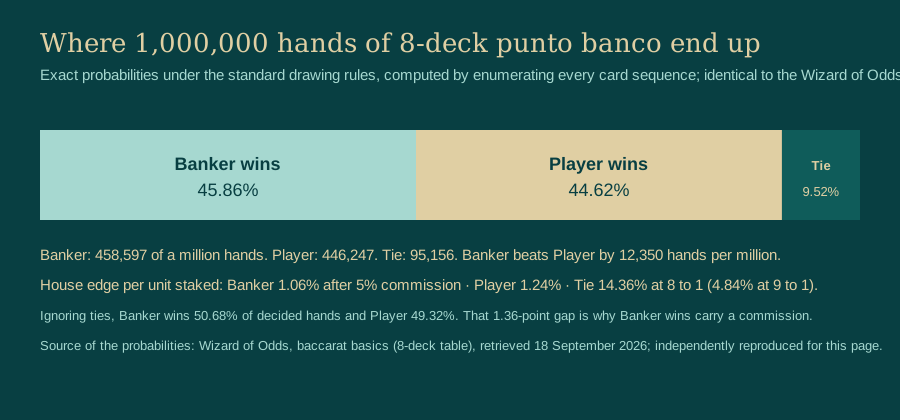
The Wizard of Odds page gives the outcome probabilities for a standard eight-deck shoe as Banker 0.458597, Player 0.446247, Tie 0.095156, from a total of 4,998,398,275,503,360 card combinations. We reproduced those figures independently. The method: an eight-deck shoe holds 416 cards, 128 of value zero and 32 of each value 1 to 9. Deal the first four cards in order and multiply the probability of each draw (for example 128/416 for a zero, then 127/415 for a second zero). Apply the natural check. If the Player total is 0 to 5, extend the sequence by one card; if the Banker rule then says draw, extend it by one more. Sum the probability of every sequence under each outcome. There are 10,000 four-card starting positions and at most 1,000,000 six-card sequences, so the enumeration is exact, not simulated.
| Outcome | Probability | Per million hands | Pays | Expected result per £1 staked | House edge |
|---|---|---|---|---|---|
| Banker wins | 0.458597 (45.86%) | 458,597 | 1 to 1 less 5% commission | −£0.010580 | 1.06% |
| Player wins | 0.446247 (44.62%) | 446,247 | 1 to 1 | −£0.012351 | 1.24% |
| Tie | 0.095156 (9.52%) | 95,156 | 8 to 1 | −£0.143596 | 14.36% |
| Tie (where offered) | 0.095156 (9.52%) | 95,156 | 9 to 1 | −£0.048440 | 4.84% |
Our enumeration also splits the outcomes by how many cards were dealt, which the published table does not. Hands ending on four cards: Banker 17.16%, Player 17.16%, Tie 3.57%. Five cards: Banker 15.68%, Player 11.99%, Tie 2.67%. Six cards: Banker 13.02%, Player 15.48%, Tie 3.27%. On four-card hands, where neither drawing rule has acted, the two sides are identical to six decimal places, because the procedure is symmetric until someone draws. The entire Banker advantage arrives on five- and six-card hands, which is exactly where the two-branch Banker rule operates.
The same page gives the six-deck figures as Banker 1.06%, Player 1.24% and Tie 14.44%, and single-deck as 1.01%, 1.29% and 15.75%. Deck count moves the Tie edge noticeably and the two main wagers barely at all.
Sources: Wizard of Odds: Baccarat basics.
Commission and the house edge, worked through
The Massachusetts rules describe the commission at section 8(a)(1) as "a vigorish from the winning players in an amount equal to 5% of the amount won". So a £1 Banker wager that wins returns the £1 stake plus 95p; a £1 Player wager that wins returns the stake plus £1. A tie is a push for both: the stake comes back and nothing is won or lost, which is why the Tie probability appears in the arithmetic below only through the two other probabilities.
Expected result per £1 on Banker: win 0.95 with probability 0.458597, lose 1 with probability 0.446247, and nothing with probability 0.095156.
0.458597 × 0.95 = 0.435667. Subtract 0.446247. Result −0.010580, which is a house edge of 1.06% of the stake. Wizard of Odds prints 0.435668 for the Banker return line, the difference being rounding at the sixth decimal.
Expected result per £1 on Player: 0.446247 − 0.458597 = −0.012350, a house edge of 1.24%. (To six places our enumeration gives −0.012351; the published rounding is 1.24% either way.)
Expected result per £1 on Tie at 8 to 1: win 8 with probability 0.095156, lose 1 with probability 0.904844. That is 0.761248 − 0.904844 = −0.143596, a house edge of 14.36%. Where a table pays 9 to 1, the win term becomes 0.856404 and the edge falls to 4.84%. Wizard of Odds notes that "almost all casinos pay 8 to 1 on a tie, which is often expressed as the equivalent to 9 for 1"; "9 for 1" and "9 to 1" are not the same offer, and the difference is the whole of the gap between 14.36% and 4.84%.
All three published figures, 1.06%, 1.24% and 14.36%, therefore follow from the drawing rules and nothing else. The commission is not a separate fee added on top of a fair game. Without it the Banker wager would have an expected result of 0.458597 − 0.446247 = +0.012350 per £1, a 1.24% edge to the bettor, and no house would deal it. Five per cent of the winnings is the smallest round figure that turns that into a house advantage. The general theory of expected value and house edge is the subject of a separate publication; Odds & Ends sets out the concepts, and this page only applies them to one game.
Sources: Massachusetts Gaming Commission: Baccarat rules, s. 8(a)(1); Wizard of Odds: Baccarat basics.
Is the card game baccarat actually 50/50?
No, on two counts, and the numbers say by how much. Across all hands the split is Banker 45.86%, Player 44.62%, Tie 9.52%, so neither main outcome reaches half. If ties are set aside, because they return both stakes, then of the 90.48% of hands that are decided the Banker takes 0.458597 ÷ 0.904844 = 50.68% and the Player 49.32%. The Banker wins 12,350 more hands per million than the Player.
That 1.36-point gap is small enough that a session of a hundred hands will often show the Player ahead, and it is why the game is described as close to a coin toss. It is not close enough to be one. Over the long run a Banker wager without commission would earn its holder 1.24p per pound; with commission it costs 1.06p per pound; a Player wager costs 1.24p per pound. The "50/50" description also ignores the tie, which is nearly one hand in ten and is the only way a main wager can end without either side losing.
What the figures do not say is anything about the next hand. The probabilities are the long-run frequencies produced by the rules over a full shoe; they are not a promise about a run of ten or a hundred hands, and a scoreboard of recent results does not change them. Nor do they depend on anything either side decides, because nothing is decided. That is also the direct answer to whether the game is skill or luck: with the drawing procedure fixed by rule, the only choices are which of the three wagers to place and how much to stake, and those choices alter the expected loss rate, not the chance of winning a given hand.
No-commission tables, the tie, and what an online rules page must show
A table advertised as commission-free has replaced the 5% deduction with a different clause, and the clause matters more than the label. Two are common. In the version Wizard of Odds lists as Nepal baccarat, Super 6 or Punto Banco 2000, a Banker win with a total of 6 pays half. Our enumeration puts a winning Banker 6 at 0.053864 of all hands, the same figure the Wizard of Odds appendix gives; that page states a Banker house edge of 1.46% on eight decks, and the arithmetic agrees: 0.458597 − 0.446247 − (0.053864 × 0.5) = −0.014581. Removing the commission has raised the house edge, not lowered it.
In EZ Baccarat, defined in the Massachusetts rules as "a variation of Baccarat in which vigorish is not collected", a winning Banker three-card 7 (the "Dragon 7") pushes instead of paying. That event has probability 0.022534, and Wizard of Odds gives the resulting Banker house edge as 1.02%; our figure is 0.458597 − 0.446247 − 0.022534 = −0.010184. This one is marginally cheaper than the commission game. The point is not which is better but that the answer cannot be read off the word "commission"; it has to be computed from the exception. The shorter note on the commission line makes the same argument from the settlement side.
The Tie wager is a different kind of proposition again. Its 9.52% frequency is fixed by the same drawing rules, but its edge is set almost entirely by the payout figure, and the payout is the one line that varies most between operators. Checking it is a matter of reading, not calculating.
For a game offered to customers in Great Britain, that reading is something the operator is required to make possible. The Gambling Commission's Remote gambling and software technical standards, RTS 3, are aimed at enabling "customers to make informed decisions about whether to gamble based on their chances of winning, the way the game, lottery or event works, the prizes or payouts on offer". Requirement 3A: "An explanation of the applicable rules must be easily available to the customer before they commit to gamble. The content including artwork and text must be accurate, and sufficient to explain all of the applicable rules and how to participate." Requirement 3C adds that information on the chances of winning must be easily available before the customer commits, and may be given as a house edge or margin, a return-to-player percentage, or the probability of winning events. Requirement 3D covers "the potential prizes and payouts or the means by which these are calculated".
Read against this page, that means the drawing table, the commission or its replacement clause, and the tie payout should all be findable in a licensed game's own rules before a stake is placed. Where an online game's help page gives a drawing table, it can be checked line by line against the one above. Where it gives a house edge for the Banker wager of 1.06%, it is describing a 5% commission game on the standard rules; a figure of 1.46% or 1.02% points to one of the exceptions. What the standard does not do is fix the rules themselves; a licensed game may lawfully use a different drawing procedure or a different tie payout provided it says so. A rules page that omits the third-card table, or shows one that differs from the published rule without saying why, is the thing to notice. How those rules are presented on a live-dealer stream, with its decision timers and round records, is outside this page's scope; Live Table Notes covers the streaming side.
Sources: Wizard of Odds: Baccarat appendix 6, commission-free variants; Wizard of Odds: EZ Baccarat; Massachusetts Gaming Commission: Baccarat rules, s. 1; Gambling Commission: RTS 3.
Rule sources
- Baccarat: rules, odds and strategy, Wizard of Odds, retrieved 18 September 2026.
- Baccarat rules, 11 April 2024, Massachusetts Gaming Commission, retrieved 18 September 2026.
- RTS 3: Rules, game descriptions and the likelihood of winning, Gambling Commission, retrieved 18 September 2026.
- Baccarat appendix 6: commission-free Banker variants, Wizard of Odds, retrieved 18 September 2026.
- EZ Baccarat, Wizard of Odds, retrieved 18 September 2026.